A microsound technique for generating pitched tones, noise bands, and rhythmic textures from trains of electronically generated sonic particles.
Overview
Pulsar synthesis generates electronic sound from trains of sonic particles called pulsarets. Each pulsaret is a brief waveform, typically lasting between a few microseconds and around 50 milliseconds, shaped by an amplitude envelope. These particles are emitted in periodic or stochastic trains. When the train rate enters the audio frequency range (above roughly 20 Hz), the result is a pitched tone whose timbre is determined by the waveform and envelope of the individual pulsaret. Below audio rate, the train is perceived as a rhythm.
The technique was proposed by Curtis Roads in the late 1990s and formalised in Microsound (2001). It belongs to the broader family of particle-based synthesis methods that descend from Dennis Gabor's acoustical quanta▸ (1946, 1947) and Iannis Xenakis's work on granular synthesis▸.
Pulsar synthesis differs from granular synthesis in several respects. Where granular synthesis typically works with stored sound samples or sustained grains of synthetic waveforms, pulsar synthesis operates with electronically generated particles whose waveform and envelope are independently variable parameters. The separation of pulsaret waveform (which determines spectral content) from pulsaret envelope (which determines bandwidth and formant structure) gives the technique a distinctive parametric architecture.
Genealogy
Roads describes pulsar synthesis as a method that "melds established principles within a new paradigm" (Roads 2001). Its lineage runs along three distinct threads: the filtered pulse trains of analog electronic music, the particle-based formant synthesis techniques of the 1970s and 1980s, and the microsound paradigm descending from Gabor.
Filtered pulse trains (1950s-1960s). In its basic form, pulsar synthesis "generates electronic pulses and pitched tones similar to those produced by analog instruments such as the Ondioline (Jenny 1958) and the Hohner Elektronium (introduced in 1950), which were designed around the principle of filtered pulse trains" (Roads 2001). The same principle was central to studio practice in the elektronische Musik▸ of the Cologne studio: Karlheinz Stockhausen and Gottfried Michael Koenig used filtered impulse generation as a staple of their craft. Stockhausen's theoretical essay . . . wie die Zeit vergeht . . . (1957) articulated the continuity between rhythm and pitch as a single temporal continuum traversed by acceleration -- the perceptual territory that pulsar synthesis makes directly playable through its fundamental frequency parameter.
Particle-based formant synthesis (1970s-1980s). A pulsaret with a sharp attack and exponential decay reproduces "a well-known configuration for formant synthesis, as seen in techniques such as window function synthesis, VOSIM (Kaegi and Tempelaars 1978), and FOF (Rodet 1984)" (Roads 2001). Roads positions these formant synthesis▸ techniques as special cases of pulsar synthesis: where FOF fixes the waveform (a sine) and constrains the envelope, pulsar synthesis leaves both freely variable.
Microsound (1946-2001). Dennis Gabor proposed that any sound can be decomposed into elementary acoustical quanta▸ -- short time-frequency atoms, finite in both time and frequency, occupying a cell in the joint time-frequency plane whose minimum area is bounded by the uncertainty principle (Gabor 1946, 1947). Iannis Xenakis gave the particle paradigm its first compositional framework with granular synthesis▸. Pulsar synthesis "belongs to a larger family of microsonic or particle synthesis techniques" (Roads 2001), but within this family its parentage is specific: it descends from the impulse and formant traditions above, not from the granulation of sampled sound.
Curtis Roads (1991-2001) developed pulsar synthesis from an initial implementation in James McCartney's Synth-O-Matic (1991), used to compose Clang-tint (1994), through a SuperCollider 1 instrument coded with Stephen T. Pope (1997), to the PulsarGenerator application built with Alberto de Campo in SuperCollider 2 (1999-2001). His contribution was to identify a parametric space these traditions had left unexplored: the independent control of pulsaret waveform, pulsaret envelope, and train characteristics (fundamental frequency, formant frequency, density), reconfigured as digital wavetables within the microsound▸ framework. As a digital technique it "accrues the advantages of precise programmable control, waveform flexibility, graphical interface, and extensibility" (Roads 2001).
The following SC2 code is the original basic pulsar synthesis instrument created by Curtis Roads with Stephen T. Pope (1997). It declares wavetables for the pulsaret waveform, amplitude, fundamental frequency, formant frequency, and spatial position. Each parameter is read from a control table via Ktransient, and Apulse generates the pulsarets. The binary .Synth file also contains the wavetable data itself (waveform, envelopes, control trajectories) as embedded float arrays.
-- P U L S A R  S Y N T H E S I S
-- Copyright 1997 Curtis Roads

-- A basic pulsar generator, with envelopes for:
--  overall amplitude of a pulsar train
--  fundamental frequency
--  formant frequency
--  spatial envelope
-- The pulsaret waveform is arbitrary and can be changed.

-- Declare the outputs
defaudioout L, R;

-- Declare the wave tables and envelopes
deftable wave, ampl, fundamental, formant, spatial_position;

start {

    -- Declare local variables
    var pulsar, a_env, fun_env, form_env, pos_env, dur;

    dur = 10.0;

    a_env = Ktransient(ampl, dur, 1, 0, `dspRemove);
    fun_env = Ktransient(fundamental, dur, 1, 0, `dspRemove);
    form_env = Ktransient(formant, dur, 1, 0, `dspRemove);
    pos_env = Ktransient(spatial_position, dur, 1, 0, `dspRemove);

    pulsar = Apulse(wave, 0, 0);

    {   (pulsar.value(fun_env.value, form_env.value) *! a_env.value)
                .pan2out(pos_env.value, L, R);
    }.dspAdd;
}Apulse UGen reads an arbitrary pulsaret waveform and is controlled by wavetable-driven envelopes for fundamental frequency, formant frequency, amplitude, and spatial position. Source: Curtis Roads (1997).The pulsaret is related to but distinct from several precursors: the Klangbaustein▸ (sound building block) concept in early German electronic music; the grain in Xenakis and Roads's granular synthesis; and the wavelet in mathematical signal analysis. Roads explicitly positions the pulsaret as a particle that is neither a grain (too long, too tied to stored samples) nor a sample (too short, no envelope shaping). In advanced practice, both the waveform and envelope tables can be loaded from a sound sample; the pulsaret waveform and envelope remain architecturally distinct, but the resulting pulsaret begins to resemble the windowed grain of granular synthesis, and the boundary between the two techniques blurs. The lexical question of what to call the micro-element -- atom▸, grain▸, quantum▸, unit▸, sample▸, dictionary entry▸, event▸ -- is itself substantive, since each term carries a different lineage and commits the work to different conceptual operations.
Pulsaret construction
A pulsaret is the product of two lookup tables: a pulsaret waveform table and a pulsaret envelope table. In the original Pulsar Generator program by Roads and de Campo, each table is an array of 2048 floating-point values that can hold any arbitrary shape. The synthesiser reads through both tables in parallel and multiplies them sample by sample. The waveform determines the spectral content of the particle; the envelope shapes its amplitude over time. Their product is the pulsaret -- the elementary sonic particle emitted at each period of the pulse train.
This separation of waveform and envelope into independently controllable tables is a defining architectural feature of pulsar synthesis. It allows the composer to design timbres by combining any waveform with any envelope, producing a parametric space far larger than either table alone. Where granular synthesis derives timbral variation primarily from the choice of source material, grain duration, and grain density, pulsar synthesis adds the independent axes of waveform shape, envelope shape, and decoupled formant frequency, expanding the space of achievable timbres without requiring any source material at all.
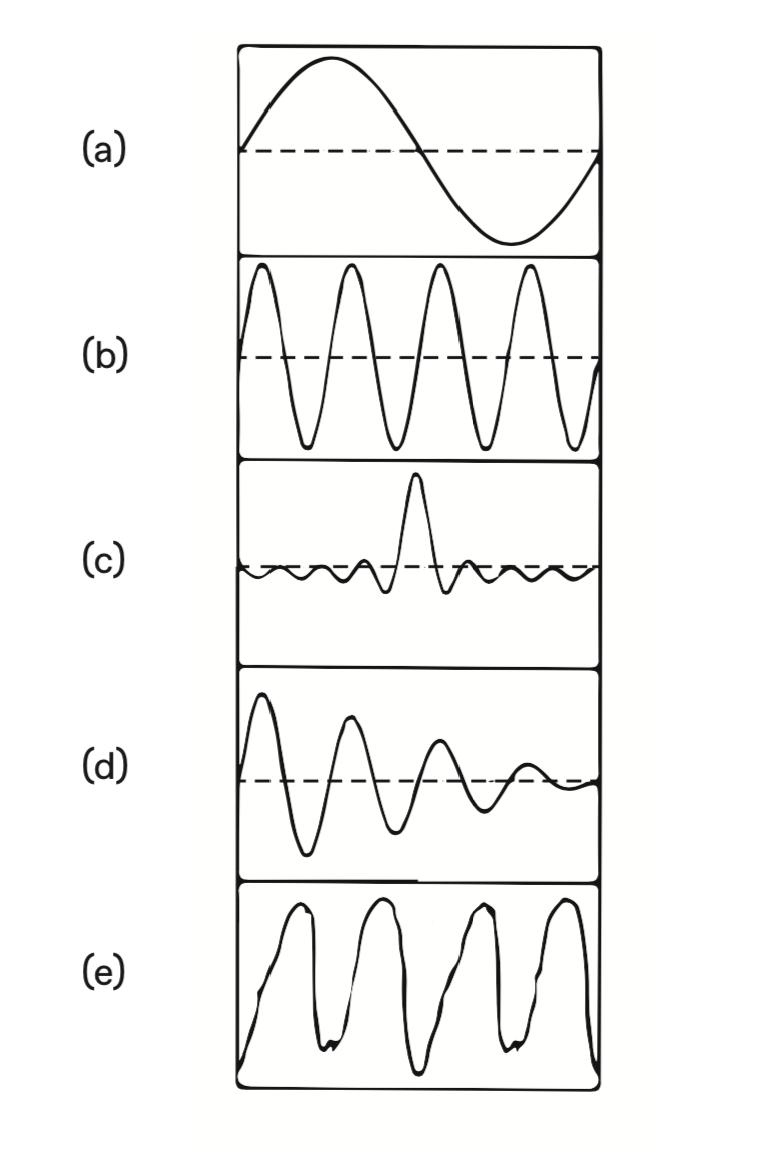
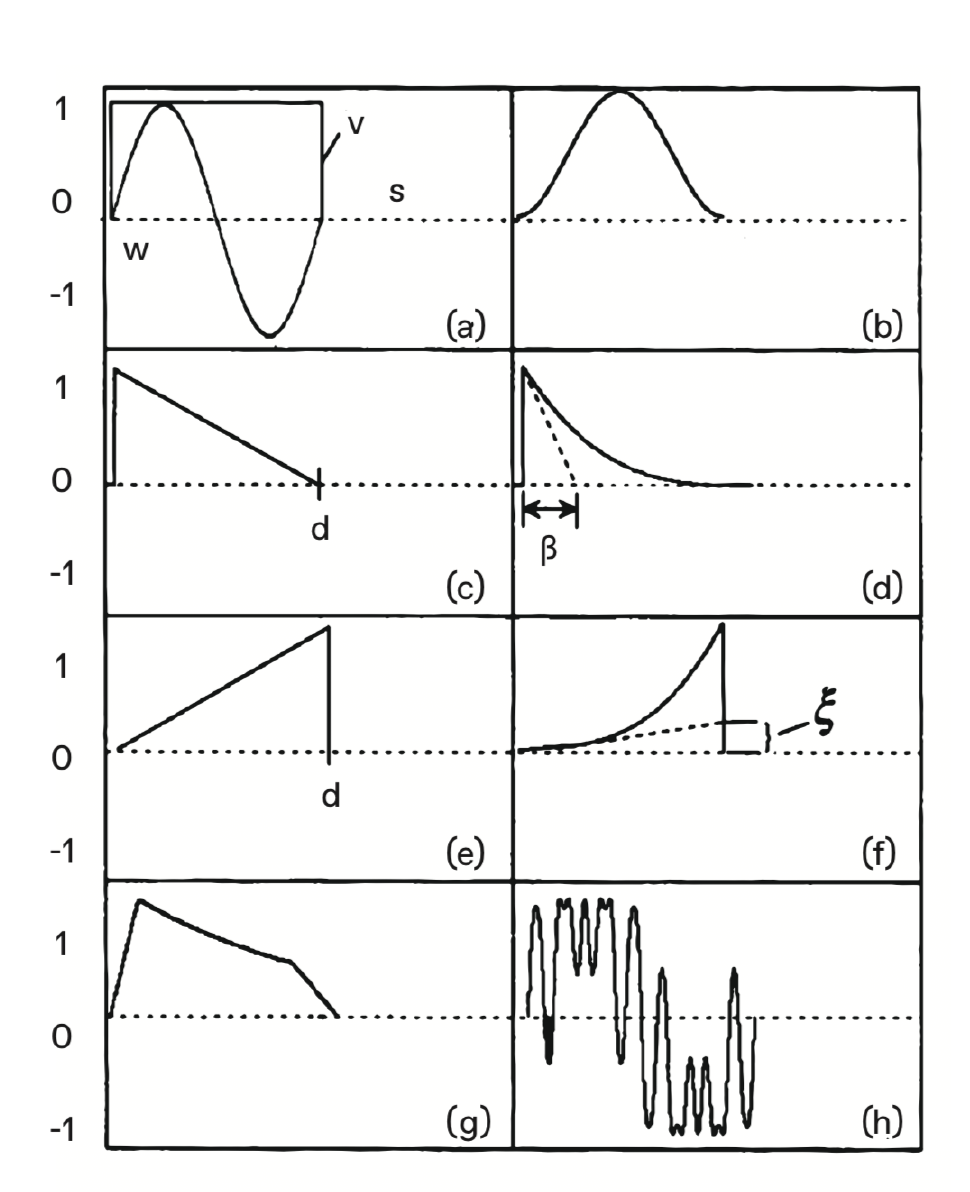
The choice of envelope determines the spectral bandwidth of the pulsaret: a narrow envelope (such as a Gaussian or exponential decay) concentrates energy around the formant frequency and produces a sharp resonant peak, while a wide envelope approaching the full period yields a nearly pure tone. The choice of waveform determines the fine spectral structure within that bandwidth -- a sine produces a single formant peak, a sawtooth fills in the harmonics, and a noise waveform distributes energy stochastically. Because the two tables are multiplied sample by sample, every combination of waveform and envelope produces a distinct spectral profile. The catalogues above show standard shapes, but in practice both tables can hold any arbitrary curve, hand-drawn or algorithmically generated.
How it works
A pulsar synthesiser generates sound through the following process:
-
Pulsaret waveform: A single cycle (or partial cycle) of a waveform -- sine, cosine, or an arbitrary shape stored in a wavetable▸. This determines the spectral content of each particle.
-
Pulsaret envelope: An amplitude envelope applied to the waveform. The envelope's shape and duty cycle control the bandwidth and formant characteristics. A narrow duty cycle (short envelope relative to the period) produces a broadband impulse; a wide duty cycle (envelope fills the period) produces a pitched tone closer to a conventional oscillator.
-
Pulse train: The pulsarets are emitted at a fundamental frequency f. When f is in the audio range, the train produces a pitched tone. The relationship between f and the pulsaret's internal waveform frequency creates the characteristic formant▸ structure of pulsar tones.
-
Inter-pulse silence: The gap between successive pulsarets (the silent portion of each period) is a defining feature. As the duty cycle decreases, more silence enters the signal, and the spectrum broadens. At the limit, an infinitely narrow pulsaret produces a click train with a flat spectrum.
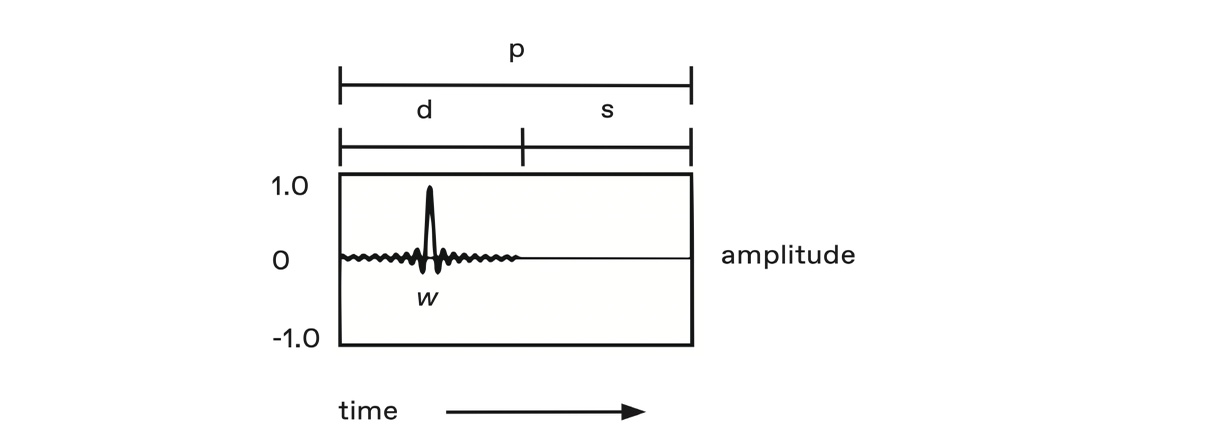
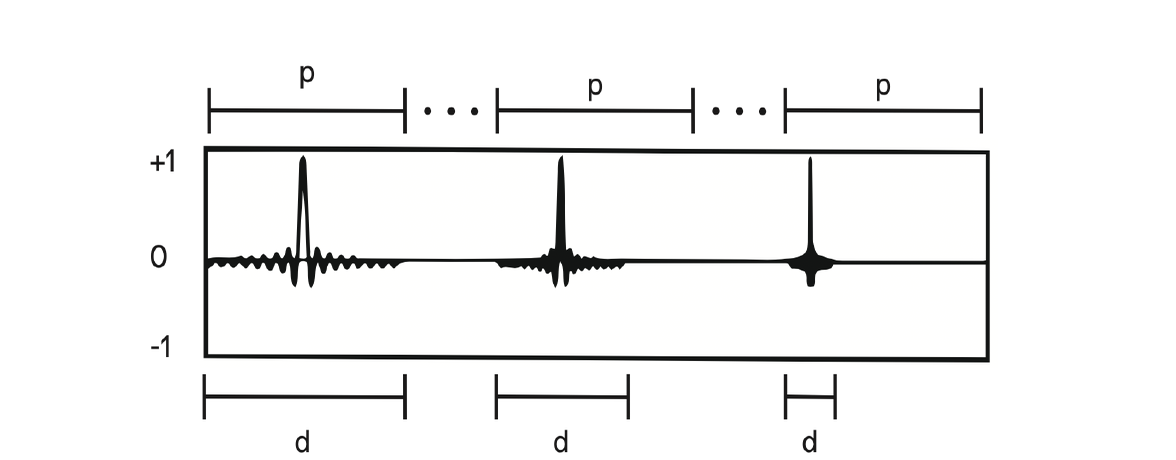
The fundamental frequency f determines the perceived pitch. The ratio of pulsaret duration to period (the duty cycle or width) determines the spectral envelope. The pulsaret waveform determines the fine spectral structure within that envelope.
Parameters
The core parameters of a pulsar synthesiser and their perceptual correlates:
| Parameter | Range | Perceptual effect |
|---|---|---|
| Fundamental frequency (f) | sub-audio to audio (0.1 Hz -- 5 kHz+) | Pitch (audio rate) or rhythm (sub-audio) |
| Pulsaret waveform | sine, arbitrary wavetable | Spectral content, timbre character |
| Pulsaret envelope | Gaussian, raised cosine, exponential, arbitrary | Bandwidth, formant shape |
| Duty cycle (width) | 0.0 -- 1.0 | Spectral bandwidth: narrow = broadband, wide = tonal |
| Formant frequency | independent of f | Resonant peak in the spectrum |
| Train density | 0.0 -- 1.0 | Proportion of periods containing a pulsaret vs silence |
The parametric independence of these dimensions is what distinguishes pulsar synthesis from related techniques. Fundamental frequency and formant frequency are decoupled, permitting effects analogous to the source-filter model▸ of speech (varying pitch independently of resonant formant structure). Train density allows smooth transitions between periodic pitched tones and sparse, rhythmic textures.
Code examples
SuperCollider 3 implementation
The code below is the exact SynthDef used by the interactive demo. Copy and run it in SuperCollider to hear the same synthesis on your machine. The pulsaret waveform is a sum of the first 10 harmonics stored in a buffer; the pulsaret envelope is a percussive shape in a second buffer. GrainBuf reads the waveform once per impulse trigger, at a rate set by the formant frequency.
// -- Wavetable data --

// Pulsaret waveform: sum of first 10 harmonics (random amplitudes)
a = Signal.sineFill(1024, 1/(1..10).scramble).putLast(0);
x = Buffer.sendCollection(s, a, 1);

// Pulsaret envelope: percussive shape
b = Env.perc.discretize(1024).putLast(0);
y = Buffer.sendCollection(s, b, 1);

// -- SynthDef --

(
SynthDef(\handbook_pulsar, { |out = 0, wavebuf = 0, envbuf = 1,
    fund = 100, form = 400, amp = 0.2, gate = 1|
    var trig = Impulse.ar(fund);        // pulse train at fundamental freq
    var grDur = form.reciprocal;         // pulsaret duration from formant
    var rate = form * BufDur.kr(wavebuf); // playback rate for wavetable
    var sig = GrainBuf.ar(1, trig, grDur, wavebuf, rate, 0, 4, 0, envbuf);
    var ampEnv = EnvGen.kr(Env.asr(0.01, 1, 0.05), gate, doneAction: 2);
    Out.ar(out, sig * amp * ampEnv);
}).add;
)

// -- Play --

z = Synth(\handbook_pulsar, [\wavebuf, x, \envbuf, y, \fund, 100, \form, 400]);

// Change parameters while running
z.set(\fund, 50);       // lower pitch
z.set(\form, 1200);     // brighter formant
z.set(\fund, 8);        // sub-audio: rhythmic pulse
z.set(\form, 200);      // darker

// Stop
z.set(\gate, 0);GrainBuf. The fund parameter sets the fundamental frequency (the rate of the Impulse trigger, perceived as pitch). The form parameter sets the formant frequency (the playback rate of the pulsaret waveform, controlling the spectral peak independently of pitch). Compare with the parameter table and the \pulsar1 SynthDef above.Instrumental implementations
Pulsar Generator (PG)
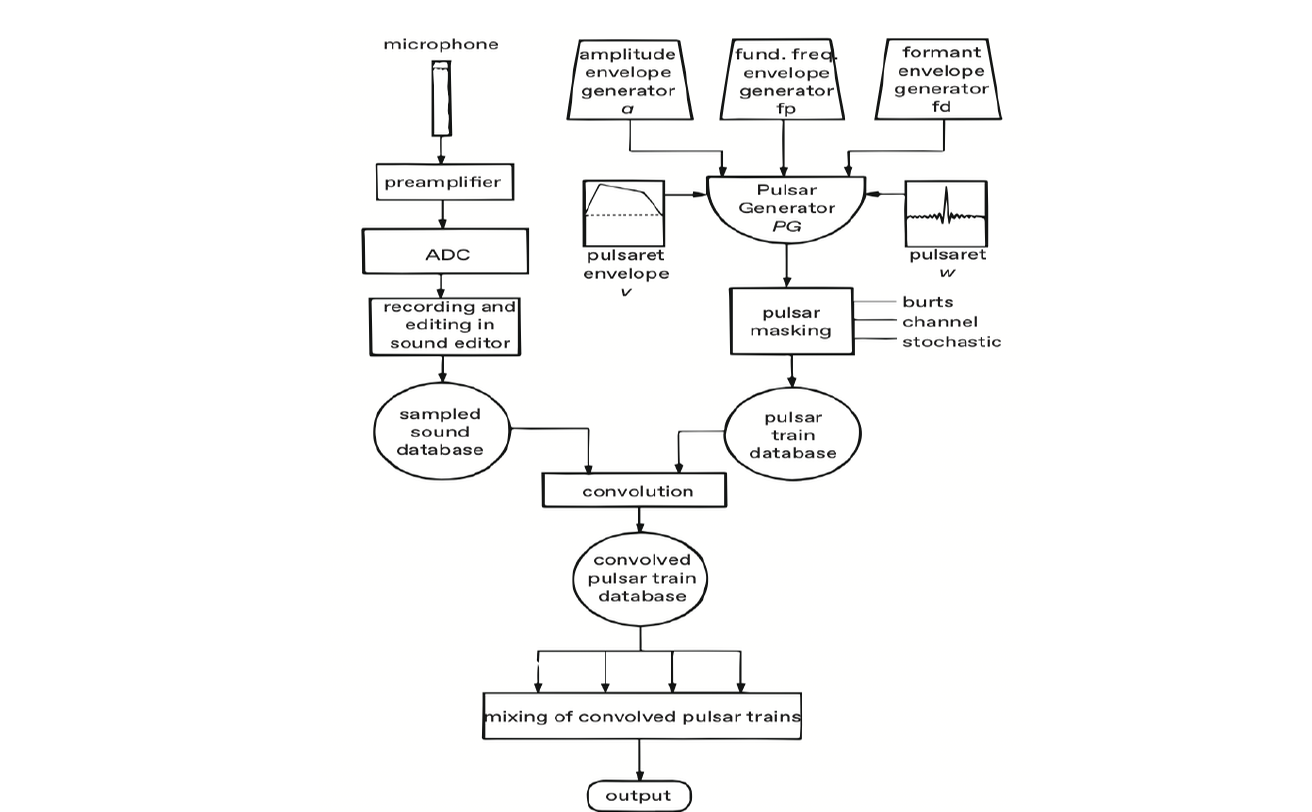
The Pulsar Generator was developed by Curtis Roads and Alberto de Campo in SuperCollider 2 at the University of California, Santa Barbara, and distributed by CREATE. It is the first instrumental encapsulation of the pulsar synthesis technique, providing wavetable-driven control over all core parameters: pulsar train duration, fundamental and formant frequency envelopes, pulsaret waveform and envelope, amplitude, and spatial path. The interface extends the basic synthesis engine with pulsar masking (burst, channel, and stochastic masking modes), convolution with sampled sounds, and multi-channel mixing (Fig. 07).
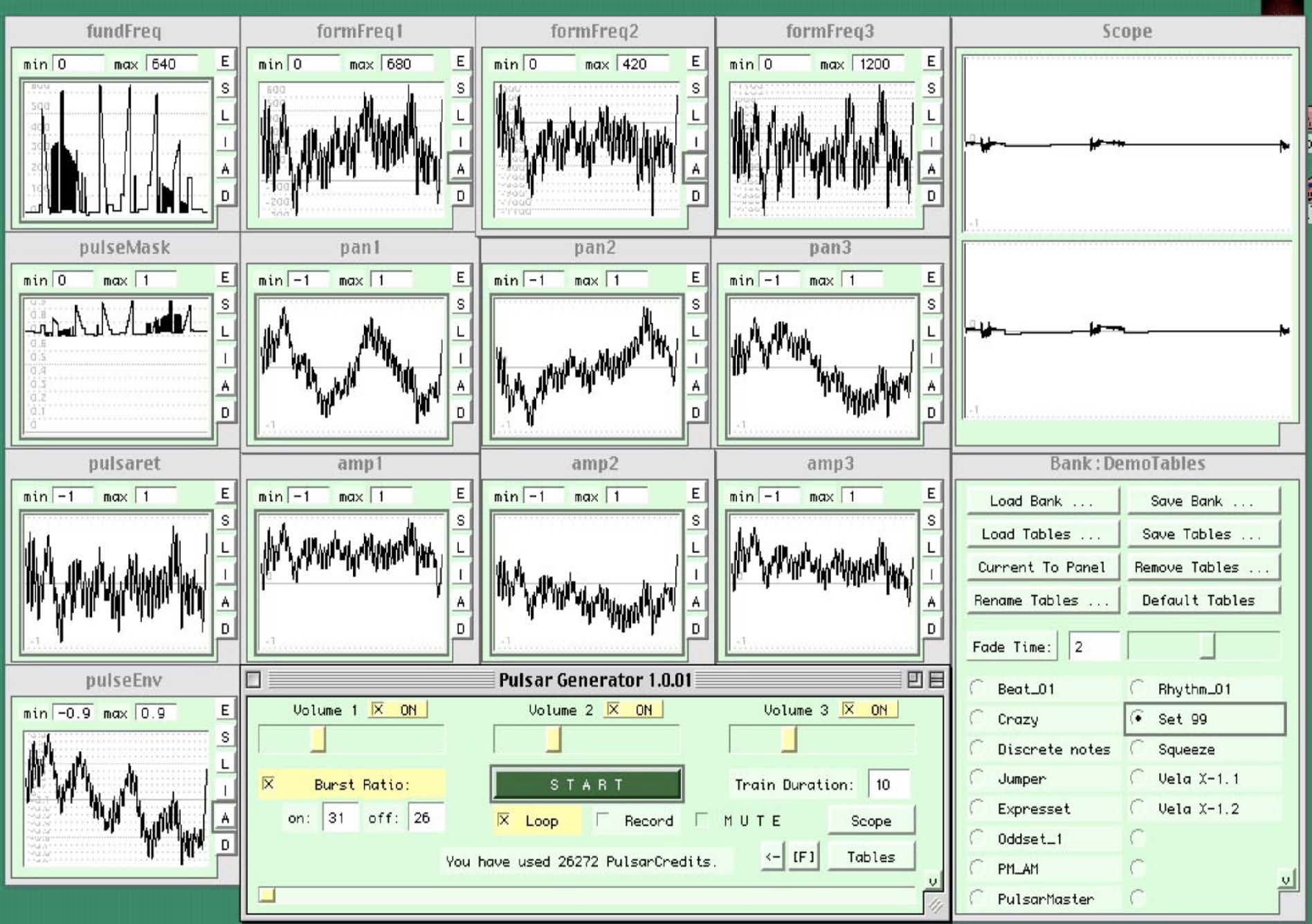
The program generates three simultaneous pulsar trains sharing one fundamental frequency table, each with independent formant, panning, and amplitude tables. This design dates back to Roads's first SuperCollider 1 sketches of 1997, where the configuration was called "additive": a unified clocking mechanism synchronises all three trains from a single fundamental frequency cycle, which around 2000 also kept processing costs low. The result is a conception of polyphony specific to pulsar synthesis -- not multiple independent voices but multiple spectral-spatial interpretations of a single temporal stream (Pietruszewski 2024, 2026). The original SC1 script survives (Fig. 06): three Apulse generators read the same pulsaret waveform and are driven by one shared fundamental frequency envelope, while each follows its own formant and spatial position envelope.
-- P U L S A R  S Y N T H E S I S
-- Copyright 1997 Curtis Roads

-- An additive pulsar generator. The pulsar streams share a common
-- fundamental frequency and waveform, but follow different formant
-- and spatial envelopes.

-- Declare the stereo output channels
defaudioout L, R;

-- Declare the wavetable and envelopes
deftable wave, ampl, fundamental, formant1, formant2, formant3,
    spatial_position1, spatial_position2, spatial_position3;

 -- Pulsar instrument
start {

    -- Declare local variables
    var osc, a_env, fun_env,
        form_env1, form_env2, form_env3,
        pos_env1, pos_env2, pos_env3,
        dur;

    dur = 30.0;

    -- Overall amplitude envelope
    a_env = Ktransient(ampl, dur, 1, 0, `dspRemove);

    -- Fundamental frequency envelope
    fun_env = Ktransient(fundamental, dur, 1, 0, `dspRemove);

    -- Formant envelopes
    form_env1 = Ktransient(formant1, dur, 1, 0, `dspRemove);
    form_env2 = Ktransient(formant2, dur, 1, 0, `dspRemove);
    form_env3 = Ktransient(formant3, dur, 1, 0, `dspRemove);

    pos_env1 = Ktransient(spatial_position1, dur, 1, 0, `dspRemove);
    pos_env2 = Ktransient(spatial_position2, dur, 1, 0, `dspRemove);
    pos_env3 = Ktransient(spatial_position3, dur, 1, 0, `dspRemove);

    osc1 = Apulse(wave, 0, 0);
    osc2 = Apulse(wave, 0, 0);
    osc3 = Apulse(wave, 0, 0);

    {  (osc1.value(fun_env.value, form_env1.value) *! a_env.value)
                .pan2out(pos_env1.value, L, R);
       (osc2.value(fun_env.value, form_env2.value) *! a_env.value)
                .pan2out(pos_env2.value, L, R);
       (osc3.value(fun_env.value, form_env3.value) *! a_env.value)
                .pan2out(pos_env3.value, L, R);

    }.dspAdd;

}Pulsar_additive.sc, 1997). Three pulsar streams share a common fundamental frequency envelope and pulsaret waveform but follow different formant and spatial envelopes -- the three-train architecture later encapsulated in the PulsarGenerator application. Source: Curtis Roads (1997).Every control object in the PG is a wavetable: thirteen tables in all, each stored as an array of 2048 floating-point values and presented through an identical graphic editor regardless of its temporal level of operation. The pulsaret waveform and envelope operate at the micro scale; the formant, panning, and amplitude tables shape the train over durations of seconds to a minute. The uniform table structure offers a single control model across time scales, mobilising a view of composition as creative grafting between temporal resolutions (Pietruszewski 2024). Roads calls this concept "graphical synthesis", and it connects the PG to earlier experiments in optical sound synthesis and to Xenakis's UPIC. Editing operations reinforce the cross-scale identity: de Campo implemented clipboard functions that mix or multiply the contents of one wavetable into another with automatic range scaling, so an amplitude envelope can be imposed directly onto a formant trajectory (Roads 2001, PG manual). Parameter states are stored as settings in a bank of sixteen slots, with variable-rate crossfading between them -- a scheme that, as Roads notes, "takes performance with PulsarGenerator to another level of musical complexity" (Roads 2001, Microsound).
The implementation is compact: the entire program, including the graphical interface, required fewer than 1,500 lines of SuperCollider 2 code, with McCartney's real-time engine calculating the samples. Particle scheduling dominates the computational cost -- at infrasonic emission rates the PG used under 4% of a 500 MHz PowerPC G4; a three-formant instrument at a 2 kHz fundamental, emitting six thousand pulsars per second, consumed roughly 45% (Roads 2001, Microsound).
The PG was thus shaped by the material conditions of computing circa 2000: the processing limits of Mac OS 9 and the buffer management strategies of that era. The 2048-point table and the quantization of parameter updates to the emission rate were pragmatic responses to these constraints, but they simultaneously encode a specific temporal ontology -- musical time as discrete, recursive, and quantized -- in which the basic unit of temporal organization is not the continuous signal but the discrete event (Pietruszewski 2026). The design also embeds a compositional stance: the PG emphasises micro- and meso-temporal organisation and was conceived as a generator of sound material to be edited, transformed, and mixed in later stages, rather than a composer of finished macroform. Haworth (2015) reads the PG, alongside GENDYN, as a cultural object: a synthesis procedure functioning as a text within the discursive and aesthetic practices of electroacoustic music. Its recorded traces bear this out, from Marcus Schmickler's transformation of PG material on Altars of Science (2007) to Florian Hecker's presentation of raw, unprocessed PG output in Pulsar Wg'lett (2006).
New Pulsar Generator (nuPG)
The New Pulsar Generator (nuPG) is a reimplementation and extension of the Pulsar Generator developed by Marcin Pietruszewski (2021). Built in SuperCollider 3, nuPG preserves the core parametric architecture of the original while expanding the synthesis engine and interface.
The reimplementation retains the PG's 2048-point table structure and emission-rate quantization even though contemporary systems could support arbitrary table sizes and sub-sample precision. These constraints persist as conceptual commitments rather than technical necessities: to discard them would be to discard the conception of digital temporality that makes pulsar synthesis distinctive (Pietruszewski 2026). Where the original PG was a closed application whose synthesis logic sat behind a graphical interface, nuPG exposes that logic as readable, modifiable code, making the historical design decisions available for inspection through use. The design lineage connecting Xenakis's UPIC, the PulsarGenerator, and nuPG shows digital instruments carrying their design histories as active artifacts (Pietruszewski 2020).
Aesthetics and cultural context
Pulsar synthesis occupies a distinctive position in the landscape of sound synthesis techniques. It emerged from a specific intellectual tradition -- the microsound▸ paradigm -- that sought to theorise electronic sound at temporal scales below the note and above the sample. This tradition, running from Gabor through Xenakis to Roads, is itself marked by the disciplinary crossings that SYNCULTURE investigates: mathematics (quantum theory, stochastic processes), engineering (signal processing, filter design), and musical composition (electroacoustic and computer music).
Several features of pulsar synthesis make it a productive case study for the analysis of synthesis as a cultural technique:
The particle as compositional primitive. Pulsar synthesis foregrounds the particle rather than the waveform, the note, or the sample as the fundamental unit of musical material. This represents a specific epistemological commitment: that sound is best understood and manipulated not as a continuous wave but as a stream of discrete events. The commitment has roots in Gabor's information theory, but its musical interpretation is not determined by the physics -- composers have made radically different aesthetic choices within the particle paradigm.
The duty cycle as timbral continuum. The duty cycle parameter exposes a continuous transition between pitched tone and broadband noise within a single synthesis mechanism. In classical synthesis, these are typically separate domains (oscillators vs noise generators). Pulsar synthesis dissolves this boundary, suggesting that pitch and noise are endpoints of a single parametric axis rather than categorically different phenomena.
Formant structure without physical models. The decoupled formant frequency parameter produces spectral resonances reminiscent of vocal or instrumental formants without any reference to a physical source. This is a form of nonstandard synthesis▸ in the sense defined by Holtzman (1978) -- the sound is specified algorithmically rather than by modelling a physical system. The resulting timbres evoke vocal qualities while remaining irreducibly synthetic.
Micro-macro temporal bridging. Because the fundamental frequency parameter can span from sub-audio rhythmic rates to audio-frequency pitches, pulsar synthesis makes audible the continuity between rhythm and pitch that is central to the microsound thesis. A single parameter sweep can traverse the perceptual boundary between discrete pulses and fused tone, demonstrating what Roads calls the time scale continuum▸.